





Introduction
Most people spend more time picking a smartphone than choosing a term insurance plan. Yet a wrong insurance decision can leave your family unprotected for decades.
If you have started looking at term insurance, you have probably already hit a wall of confusion. Should you go with the brand you have heard of? The one with the lowest premium? The one your agent recommends? None of these questions will give you the right answer on its own.
Comparing term insurance plans based on key factors, such as claim settlement ratios, solvency, riders, and premiums, is the only way to make a confident, unbiased decision. That is exactly what Ditto's comparison tool is built for.
In this guide, you will learn how to use our free comparison tool, what to look for in an insurer, and how to evaluate plan features.
Need help choosing the right term insurance plan for you? or with Ditto's IRDAI-certified experts.
Friendly reminder: It's easy to get lost comparing policies and premiums. Instead of spending hours on it, why not get personalised insurance advice from Ditto? We offer free consultations with zero spam! Just 30 minutes to clarify all your doubts.
How to Compare Term Insurance Before Buying?
You can compare plans in two stages:
Company Comparison
Before comparing individual plans, compare the insurance companies behind them. A term insurance policy is a long-term commitment, so it's important to choose an insurer with a strong claims record, sound financial health, and a consistent track record. Key metrics such as the Claim Settlement Ratio (CSR), Amount Settlement Ratio (ASR), solvency ratio, business volume, and complaint volume can help you identify insurers that are more likely to honor claims when your family needs them.
Policy Comparison
Once you've shortlisted reliable insurers, compare term insurance plans based on the coverage and features they offer. While all plans provide a death benefit, they differ in riders and benefits such as Critical Illness Cover, Waiver of Premium, Terminal Illness Benefit, Zero Cost Term Insurance, and Life Stage Cover. Comparing these features alongside the premium helps you choose a policy that offers the right balance of protection, affordability, and long-term value.
How to Use Ditto's Free Online Plan Comparison Tool: Step-by-Step Guide
Start by choosing the insurance company whose plan you want to evaluate. This helps narrow down your options.
Select the specific insurance plan you want to compare. You can choose two plans to review the insurer's metrics and the plan's features and benefits side by side.
Once you've selected the insurer and plan, click the “Compare” button to generate a detailed comparison. The tool will instantly display key differences and similarities between the selected plans.
Go through the comparison carefully to understand coverage, benefits, claim settlement metrics, and other important insurer and plan details that can influence your decision.
If you have questions or need help choosing the right policy, you can get in touch with Ditto's advisors. They can clarify your doubts, explain plan nuances, and help you find the most suitable option for your needs. Moreover, if you buy the policy through us, we also help with claims assistance at no extra cost.
Why Should You Compare Term Insurance Before Buying?
Imagine two plans with nearly the same premium. One insurer settles 99.7% of claims. The other settles at 95%. That 4.7% gap might not sound dramatic. But when your family files a claim worth ₹2 crore, it is the difference between financial security and rejection. A term insurance comparison also helps you avoid paying extra for riders you do not need or missing the ones you do. Moreover, it ensures you pick an insurer that has the financial strength to honor claims 20 or 30 years from now, not just today.
How to Find the Best Term Insurer?
Before evaluating any plan's features, check whether the company behind it is trustworthy. Here are the six key metrics:
Claim Settlement Ratio (CSR)
The Claim Settlement Ratio (CSR) is the percentage of death claims an insurer settles in a given year out of the total number of claims it receives. Look for insurers with a CSR of 97% and above. Top performers in India include Axis Max Life (99.71%), Bajaj Life (99.32%), and HDFC Life (99.66%).
Ditto's Recommendation: 97%+
Amount Settlement Ratio (ASR)
The Amount Settlement Ratio (ASR) is the percentage of total claim amount an insurer has paid in a given year out of the total claim amount received. ASR is an important metric because an insurer with a high CSR but low ASR could be settling smaller claims while rejecting high-value ones. Look for insurers with an ASR of 90% and above.
Ditto's Recommendation: 90%+
Solvency Ratio
The solvency ratio tells you whether an insurer has enough financial reserves to pay claims, even during economic stress. IRDAI mandates a minimum of 1.5x. Prefer insurers with a solvency ratio above 1.8x for a wider safety cushion.
Ditto's Recommendation: Minimum 1.8x
Business Volume
A large business volume (annual new business premium collected) signals scale and financial stability. HDFC Life, for example, collected ₹33,031 crore in average annual premiums, and SBI Life collected ₹38,789 crore, making them among India's largest private life insurers. Look for larger insurers with an annual business volume exceeding ₹5,000 crore, as they are less vulnerable to sudden financial shocks.
Ditto's Recommendation: ₹5,000 Crore+
Track Record
A long track record can be a sign of stability and reliability. Look for insurers that have been in business for at least 15 years, have strong promoters or parent companies, and enjoy a good reputation in the market.
Complaint Volume (Per 10,000 Claims Received)
Look for insurers with the lowest complaint volumes, ideally under 20 per 10,000 claims. For example, HDFC Life received just 1 complaint per 10,000 claims, and Aditya Birla Sun Life received 1.33.
Ditto's Recommendation: Less than 20 complaints per 10,000 claims
These numbers are for the insurer's entire life insurance segment, including term insurance, ULIPs (Unit-Linked Insurance Plans), and savings plans. However, they are still relevant for comparing term plans.
At Ditto, we look at three-year averages (FY 2024-26) rather than quarterly or annual figures. This ensures that short-term fluctuations, market cycles, or one-off events do not distort the analysis, providing a more reliable view of long-term performance and consistency.
Talk to an expert
today and
find
the right
insurance for you.


How to Find the Best Term Insurance Plan?
All term insurance plans work the same way. Once the policyholder buys a plan, the insurance company provides coverage for the entire policy term. If they die during it, a sum assured (death benefit) is paid out to their nominees. Here's a list of common features or riders that term insurance plans have:
Critical Illness Benefit
This rider pays a lump sum if you are diagnosed with a serious illness like cancer, a heart attack, or kidney failure. The payout helps cover treatment costs and compensates for lost income during recovery. Axis Max Life's Smart Term Plan Plus covers up to 64 critical illnesses, while HDFC Life's Click2Protect Supreme Plus covers 60. Compare the breadth of coverage, survival, and waiting period before adding this rider.
Waiver of Premium
If you are diagnosed with a covered critical illness or disability and can no longer earn income, the Waiver of Premium benefit keeps your policy active without requiring you to continue paying premiums. Ditto strongly recommends this rider because your coverage should not lapse precisely when your income disappears.
Zero Cost Term Insurance
Most modern term plans come with a Smart Exit or Zero Cost option. It lets you surrender the policy at a defined window (typically after 25-40 years) and receive your base premiums back. It's a free/built-in feature in most plans. While it's not ideal to exit a term plan when you're most likely to need it the most, you still have the option to opt for it and exit. This is a better alternative to choosing a Return of Premium (ROP) plan.
Accidental Death Benefit
This rider provides an additional payout on top of the base sum assured if death results from an accident. Since all kinds of deaths are already covered in term insurance (accidental, illness, etc), you don't need to opt for this separately, unless you're ineligible for a higher base cover.
Terminal Illness Benefit
If you are diagnosed with a terminal illness, this benefit pays out the sum assured (or up to ₹1 crore, depending on the plan, partially or fully) immediately, while you are still alive. Most top plans include this as an inbuilt feature at no extra cost. However, it is a little difficult to use in practice because you're required to obtain certificates from 2 doctors confirming the demise within the next 6 to 12 months.
Top-Up Cover
Some plans allow you to increase your cover at key life stages, such as marriage, the birth of a child, or taking a home loan, without going through full medical underwriting again. This is called a Life Stage Boost or Top-Up Cover. It is a useful feature if you expect your financial responsibilities to grow significantly over time.
Accidental Total and Permanent Disability
This rider pays out a benefit if you suffer a total and permanent disability due to an accident. It ensures your family has financial support even if you survive but can no longer work or earn.
Increasing Cover With Inflation
A ₹1 crore sum assured today will be worth far less in real monetary terms 20 years from now, given inflation. Some plans, like HDFC Click2Protect Supreme Plus, offer an increasing cover feature that raises your sum assured by a fixed percentage each year. This helps keep your coverage meaningful over the long term of your policy.
However, at Ditto, we recommend using a properly sized level cover for most options, given the cost-benefit ratio. Instead of opting for an increasing cover, it is better to account for your current expenses, outstanding uninsured loans, and future goals, factor in inflation, and choose a sum assured that reflects these factors. If you need help, you can use the cover calculator on Ditto's website.
Return of Premium (ROP): Is It Worth It?
ROP plans return all your base premiums at policy maturity if you survive. It sounds attractive. But here is the reality: ROP variants typically cost 60%-100% more in annual premiums than a plain term plan. Moreover, the money returned at maturity is not inflation-adjusted. ₹10 lakh returned in 30 years buys far less than it does today.
A plain-term plan, with the premium difference invested in a mutual fund or Public Provident Fund (PPF), almost always delivers a better financial outcome. Ditto recommends skipping the ROP variant.
Best Term Insurance Plans Comparison
Once you've compared the features, see Ditto's top picks for 2026 for the best term insurance plans in India. These include:
| Metric | Axis Max Life Smart Term Plan Plus | HDFC Life Click2Protect Supreme Plus | ICICI Life iProtect Smart Plus | Bajaj Life eTouch II | Aditya Birla Sun Life Super Term Plan |
|---|---|---|---|---|---|
| Claim Settlement Ratio (Avg. FY 2024-26) | 99.71% | 99.66% | 99.30% | 99.32% | 98.70% |
| Amount Settlement Ratio (Avg. FY 2023-25) | 96.37% | 96.72% | 95.94% | 93.42% | 94.34% |
| Solvency Ratio (Avg. FY 2024-26) | 1.89x | 1.86x | 2.10x | 3.52x | 1.82x |
| Annual Business Volume in Crore (Avg. FY 2024-26) | ₹12,566.66 | ₹33,030.87 | ₹22,239.48 | ₹12,791.02 | ₹10,303.08 |
| Complaint Volume per 10,000 Claims (Avg. FY 2024-26) | 3.00 | 1.00 | 8.00 | 2.77 | 1.33 |
| Sum Assured | ₹25 lakh to no limit (depending on underwriting) | ₹50 lakh to no limit (depending on underwriting) | ₹50 lakh to no limit (depending on underwriting) | ₹50 lakh to no limit (depending on underwriting) | ₹25 lakh to no limit (depending on underwriting) |
| Entry Age | 18-60 years | 18-65 years | 18-60 years | 18-65 years | 18-65 years |
| Maximum Maturity Age | Up to 85 years, 100 years for whole life coverage | Up to 85 years | Up to 85 years, 99 years for whole life coverage | Up to 85 years, 99 years for whole life coverage | 85 years |
| Premium Payment Term | Single, regular, 5/10/12/15 pay, pay till 60 | Single, regular, limited pay (customizable) | Single, regular, limited - 5/7/10/15 pay, pay till 60 | Regular, limited, 5/6/10/12/15/20 pay, pay till 60 | Regular, limited, 5/7/10/12/15/20 pay, pay till 60 |
| Critical Illness (CI) Benefit (Add-on) | CI and disability covers 22/64 CIs, depending on the variant, for up to 20 years | Covers 60 CIs, CI term up to 15 years | Covers 20/60 CIs, depending on the option chosen, for 20 years | Covers 10/25/60 CIs, term up to 20 years | Accelerated CI option, covers 42 CIs |
| Waiver of Premium (WoP) Benefit | Paid add-on: covers 11 critical illnesses and 4 TPD conditions | Paid add-on: covers 60 illnesses, including permanent disabilities | Paid add-on: covers 15 critical illnesses and TPD due to an accident | Free built-in feature: covers accidental total and permanent disability and terminal illness | Paid add-on: covers 4 major CIs and complete disability due to illness/accident |
| Terminal Illness (Accelerated payout) | Built-in, payout up to ₹1 crore | Built-in, payout until age 80, and up to ₹2 crore | Built-in, the entire sum assured is paid out | Built-in, payout up to ₹2 crore | Built-in, payout until age 80, and pays 50% of the sum assured or ₹1 crore (whichever is lower) |
| Increasing Cover Option | Smart Cover Variant pays 150% of the sum assured if the insured dies within the first 15 years. If death occurs after, it pays 100%. Optional life stage cover increase on marriage, childbirth, home purchase via loan | Built-in variant: +5% yearly or 10% every 5 years (200% cap) | Built-in option: on marriage, on the birth of up to 2 children, on a home loan | Built-in: on marriage, on the birth of up to 2 children, on a home or education loan | Add-on: on marriage, on the birth of up to 2 children, on a home loan |
Ditto's Key Insight: Once you buy a term insurance plan, your premiums get locked in for the entire duration. Moreover, when you're young, the premiums are lower, and you're less likely to have pre-existing diseases or conditions. Therefore, it's recommended to buy a term plan as soon as possible.
How Ditto Evaluates Term Insurance Plans
To help you find the best term insurance plan, we compare plans and score them based on a proprietary scoring matrix. All the plans are rated using our policy and insurer rating framework, which scores them across three dimensions and 15+ factors.
- Insurer Rating (60% Weightage)
- Features Rating (30% Weightage)
- Premium Rating (10% Weightage)
Why Choose Ditto for Term Insurance?
At Ditto, we've assisted over 8,00,000 customers with choosing the right insurance policy. Why customers like Aaron below love us:
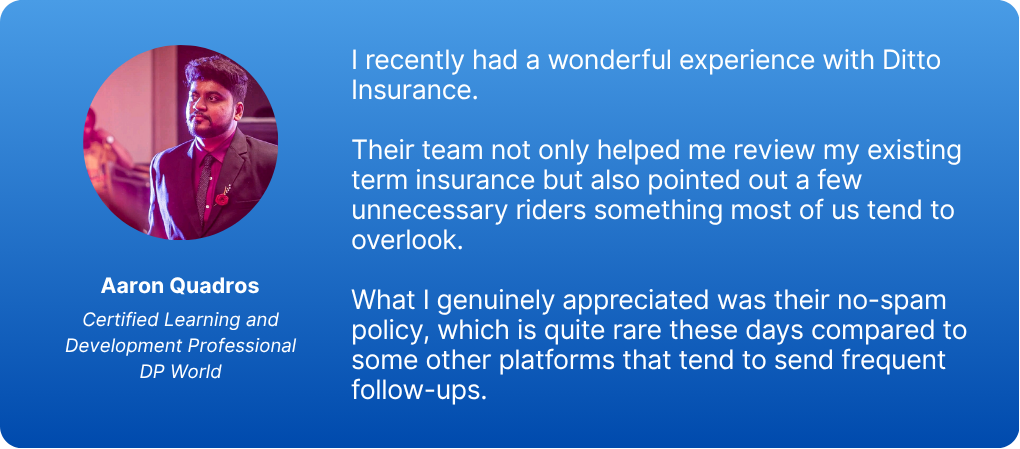
- No-Spam & No Salesmen
- Rated 4.9/5 on Google Reviews by 25,000+ happy customers
- Backed by Zerodha
- Dedicated Claim Support Team
- 100% Free Consultation
You can book a FREE consultation. Slots are running out, so make sure you or now!
Why People Trust Ditto
Frequently Compared Plans
Axis Max Life Smart Secure Plus vs ICICI Life iProtect Smart
Axis Max Life Smart Term Plan Plus vs Axis Max Life Smart Total Elite Protection
Axis Max Life Smart Secure Plus vs Axis Max Life Smart Term Plan Plus
HDFC Life Click 2 Protect Supreme vs Axis Max Life Smart Term Plan Plus
Tata AIA Maha Raksha Supreme vs ICICI Life iProtect Smart
ICICI Life iProtect Smart vs ICICI Life iProtect Smart Plus
Conclusion
Comparing term insurance plans is not about finding the cheapest option. It is about finding the plan that will actually pay out when your family needs it most.
Here is how to move forward:
- Shortlist insurers with a 3-year average CSR above 97%, a solvency ratio above 1.8x, and low complaint volumes.
- Match plan features to your life and family history: Waiver of Premium if you have income dependents, and Critical Illness Benefit if your family history warrants it. These features also help if you have low or no emergency funds.
- Avoid ROP plans or random features unless the math genuinely works in your favor. It rarely does.
Use Ditto's free comparison tool to view side-by-side data, then speak with an IRDAI-certified Ditto advisor to finalize the plan.
Frequently Asked Questions
How do I compare term insurance plans online in India?
Start by filtering on the insurer, not the plan. Check the 3-year average Claim Settlement Ratio (above 97%), Amount Settlement Ratio (above 90%), solvency ratio (above 1.8x), business volume (₹5,000 crore+), and complaint count less than 20 per 10,000 claims. Once the insurer has cleared these filters, compare plan-level features such as Critical Illness Benefit, Waiver of Premium, and terminal illness coverage. Ditto’s free comparison tool lets you review two plans side by side across all these metrics without routing you to a sales agent.
What is a waiver of premium in term insurance, and should I add it?
Waiver of Premium is a rider that keeps your policy active without requiring future premium payments if you are diagnosed with a critical illness or a disability that stops your income. It is one of the most practical add-ons available in term insurance. At Ditto, we strongly recommend adding this rider because your coverage should not lapse at the very point when your income disappears. The additional premium cost is typically small relative to the financial protection it provides for your family during a health crisis.
Which term insurance plan has the best rating in India in 2026?
Based on Ditto's proprietary rating framework, which evaluates plans across 15 plus factors, the top-rated plans in 2026 are Axis Max Life Smart Term Plan Plus, HDFC Life Click2Protect Supreme Plus, ICICI Life iProtect Smart Plus, Bajaj Life eTouch II, and Aditya Birla Sun Life Super Term Plan. Axis Max Life leads primarily because its insurer holds the highest 3-year average (FY 2024-26) CSR in India at 99.71%.
What is a critical illness benefit in term insurance, and is it worth adding?
A Critical Illness Benefit rider pays a lump sum if you are diagnosed with a serious condition like cancer, a heart attack, or kidney failure. The payout covers treatment costs and replaces lost income during recovery. Different plans cover different numbers of illnesses. Axis Max Life's Smart Term Plan Plus covers up to 64 critical illnesses, while HDFC Life's Click2Protect Supreme Plus covers 60. At Ditto, we recommend comparing the breadth of conditions covered and the waiting and survival periods before deciding whether to add this rider to your base plan.
What is zero cost term insurance or the smart exit option?
Zero Cost term insurance, also called the Smart Exit option, lets you surrender your policy during a defined window (typically after 25 to 40 years) and get your base premiums refunded. Most modern plans offer this as a feature. At Ditto, we do not recommend activating the exit. The exit window typically coincides with the phase of life when your coverage is most needed. Surrendering the plan at that stage leaves your family exposed at a critical time, which defeats the whole purpose of holding a term insurance policy.
What modern features do insurance plans offer?
Many modern insurance plans go beyond basic coverage by offering health management services such as preventive health check-ups, teleconsultations, wellness programs, and fitness tracking to support overall well-being. They may also offer premium discounts or breaks for maintaining a healthy lifestyle. Additionally, some insurers offer instant partial claim payouts, allowing policyholders to receive a portion of the approved claim amount quickly to cover urgent expenses while the remaining settlement is being processed.
Why should you compare term insurance before buying?
Imagine two plans with nearly the same premium. One insurer settles 99.7% of claims. The other settles at 95%. That 4.7% gap might not sound dramatic. But when your family files a claim worth ₹2 crore, it is the difference between financial security and rejection. A term insurance comparison also helps you avoid paying extra for riders you do not need or missing the ones you do. Moreover, it ensures you pick an insurer that has the financial strength to honor claims 20 or 30 years from now, not just today.
Talk to an expert
today and
find
the right
insurance for you.