



Overview
India is facing a growing burden of Non-Communicable Diseases (NCDs), including heart disease, cancer, diabetes, and chronic respiratory illness.
According to an April 2026 PIB press release, the Ministry of Health reported that these diseases account for around 60% of deaths in India. Beyond their health impact, these illnesses can also place a significant financial strain on individuals and families, making financial protection against critical illness an important part of financial planning.
One way to prepare for these risks is to explore critical illness cover in term insurance. This guide explains how it works, its key benefits and limitations, and how to assess whether it aligns with your financial needs.
What Is a Critical Illness Rider in Term Insurance?
A critical illness rider in term insurance is an optional benefit that pays a fixed lump sum after diagnosis of a covered illness. The payout does not depend on hospital bills. Instead, it depends on the policy definition, waiting period, survival period, and other applicable terms.
Plans With Critical Illness Rider
Note: TPD stands for Total and Permanent Disability. ABSLI Super Term Plan offers critical illness (CI) cover as an in-built optional benefit at an additional premium.
How Does a Critical Illness Rider Pay Out?
There are two types of critical illness riders, each with different payout structures.
- Standard/Additional Critical Illness Rider: Pays the critical illness benefit separately from your life cover. For example, a ₹25 lakh rider on a ₹1 crore term plan pays ₹25 lakh after an eligible diagnosis, while the full ₹1 crore death benefit remains intact for your nominee. Axis Max Life Smart Term Plan Plus and Bajaj Life eTouch II offer this option.
- Accelerated Critical Illness Rider: Pays the critical illness benefit from your existing life cover. For example, a ₹20 lakh payout from a ₹1 crore term plan reduces the remaining death benefit to ₹80 lakh, leaving your nominee with less coverage. Aditya Birla Super Term Plan offers a lump sum payout on the first diagnosis of any of its listed 42 critical illnesses, after which the benefit ends.
Once a claim is paid, the rider may terminate, ending future rider premiums. Your total policy premium may decrease accordingly, depending on the insurer’s terms and conditions.
Note: Choose your CI cover based on your income, financial obligations, dependents, and recovery period. At Ditto, we recommend starting with 6–12 months of income, subject to affordability and insurer eligibility. At Ditto, we recommend considering a Waiver of Premium (WOP) rider alongside a critical illness rider for added protection.
Which Illnesses Are Covered Under a Critical Illness Rider in Term Insurance?
Most critical illness riders cover major conditions such as cancer, heart attack, stroke, kidney failure, major organ transplants, paralysis, multiple sclerosis, and major burns. The number of covered illnesses varies by insurer and plan.
Each covered illness has a specific medical definition in the policy document. For example, early-stage cancer or a cardiac event that does not meet the stated severity criteria may not qualify for a payout. Review these definitions carefully before buying the rider.
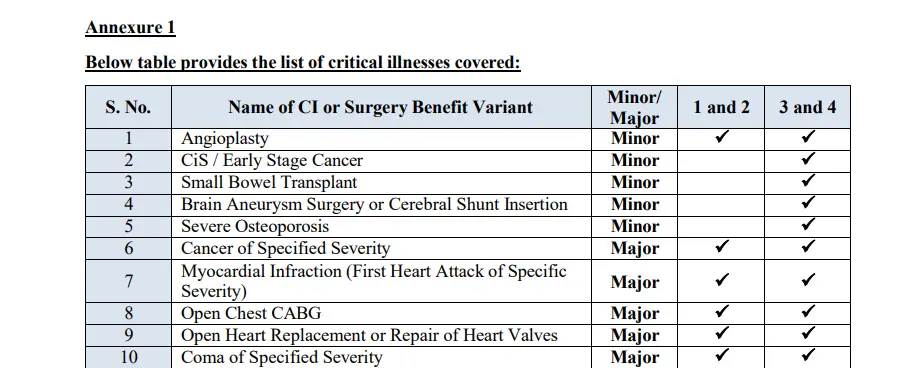
Note: Some insurers like Axis Max Life classify critical illnesses as minor or major. Under Axis Max Life STPP’s Critical Illness and Disability Rider:
- Minor illnesses like Angioplasty, CIS / Early Stage Cancer, Brain Aneurysm Surgery or Cerebral Shunt Insertion, Small Bowel Transplant, and Severe Osteoporosis pay the lower of 25% of the rider sum assured or ₹5 lakh.
- Major illnesses like Cancer of Specified Severity, Open Chest CABG, Open Heart Replacement or Repair of Heart Valves, Myocardial Infarction (First Heart Attack of Specific Severity), and Coma of Specified Severity pay the remaining eligible benefit and terminate the rider.
The full list of critical illnesses/surgeries and whether each is classified as minor or major is provided in the prospectus.
Here’s a snippet from the policy prospectus which lists the diseases covered. The rider offers 5 variants, of which variants 1, 2, 3, and 4 are shown in the snippet.
Sample Premiums: Term Insurance With Critical Illness Riders
The illustrative annual premiums are for a 25-year-old non-smoking male for a ₹2 crore sum assured with coverage until age 65. You can use the Ditto premium calculator for rough estimates of your base plan premiums.
Critical Illness Rider in Term Insurance vs. Standalone Critical Illness Policy: Which Is Better?
Note: For critical illness insurance, Ditto’s preferred approach:
- Prioritize Health Insurance: Buy a comprehensive health insurance policy first to cover hospitalisation and eligible medical expenses, reducing the risk of dipping into your savings for treatment.
- Add Term Insurance with a CI Rider: Once health insurance is in place, buy a term plan with a critical illness (CI) rider for life cover and an additional payout if you are diagnosed with a covered critical illness, subject to policy terms.
This helps cover hospitalization expenses while providing a lump sum benefit after an eligible critical illness diagnosis, subject to policy terms.

Critical Illness Rider: Key Limitations and Exclusions
Only Listed Illnesses Qualify for a Payout
A serious illness does not guarantee a claim. The condition must appear on the rider’s covered illness list and meet its specific medical definition. Some riders cover only a few conditions, while others include dozens. Check the list before buying.
Waiting Periods and Survival Conditions Apply
Critical illness riders impose a waiting period. You also need to survive for a specified period after diagnosis of a listed condition. A claim can fail if either condition is not met.
The Rider Can End After a Claim or Base Policy Termination
Many riders pay the full benefit only once and then terminate. The rider may also end if the base term policy lapses, is surrendered, or terminates. Unlike a standalone critical illness policy, it cannot continue on its own.
Coverage Duration and Benefit Amounts Are Limited
A critical illness rider can expire before your term insurance policy. However, if both have a 30-year tenure, they can remain active together until the policy ends, unless a claim triggers the rider’s termination under its terms. Insurers also impose maximum entry ages, maturity ages, and sum assured limits.
Accelerated Benefits Reduce Your Death Benefit
An accelerated critical illness rider pays from your existing life cover. A claim therefore reduces the amount available to your nominee. An additional-benefit rider pays separately. Confirm which structure your policy offers before you buy.
Note: People with Pre-Existing Diseases (PEDs) such as diabetes, hypertension, or high cholesterol may face stricter underwriting and usually do not qualify for a critical illness rider with their term insurance plan. However, approval depends on the insurer’s assessment and the condition's severity.
Why Choose Ditto for Term Insurance?
At Ditto, we’ve assisted over 12,00,000 customers with choosing the right insurance policy. Why customers like Aaron below love us:

- 100% Free Consultation
- No Spam. No Sales Pressure.
- Rated 4.9/5 on Google Reviews by 30,000+ Happy Customers
- Backed by Zerodha
- Dedicated Claim Support Team
- Compare Plans and Premiums with a Trusted Insurance Advisor
Confused about the right insurance? Speak to Ditto’s certified advisors for free, unbiased guidance. Book your call now or chat with us on WhatsApp. Slots fill up fast!
Conclusion
A critical illness rider makes sense if you are the primary earner, have dependents, or have a family history of serious illnesses such as heart disease or kidney failure. The lump sum payout can help cover treatment costs and income loss during recovery.
However, if you have comprehensive health insurance and enough emergency savings, you may not need the extra cover. If keeping premiums low is your priority, compare the cost against the protection it offers before adding the rider.
You must also consider whether the insurer will approve the rider based on your health profile and underwriting criteria.
Critical illness riders carry a higher claim likelihood than base term plans, which can lead to stricter underwriting. An insurer may approve your term cover but reject the CI rider. Compare the best term insurance plans and check rider eligibility before applying.
Term insurance premiums remain fixed throughout the policy term, and rider premiums also get locked in. This limits CI cover to a shorter duration than the base policy. Check the rider’s expiry age and coverage term before you buy.
Frequently Asked Questions
Last updated on: