



Overview
Indian life insurers issued over 270 lakh new individual policies in FY 2024-25, according to IRDAI’s annual report. This shows a clear trend: more people are buying life insurance, but many still struggle with one question: should they buy a low-cost pure term plan or pay extra for a term plan with return of premium?
TROP plans promise a simple deal: if the policyholder dies during the policy term, their nominee gets the death benefit. If they survive, the base premiums are refunded. Sounds like a win-win, right? Unfortunately, the reality is quite different.
This guide breaks down how TROP works, the popular TROP plans available, how it compares against pure term insurance, who should genuinely consider buying it, and Ditto's honest take.
What Is Term Insurance With Return of Premium (TROP)?
A Term Insurance with Return of Premium (TROP) plan is a type of term insurance that gives back the premiums you've paid if you outlive the policy term. Think of it as a "money-back" version of term insurance.
In our experience at Ditto, TROP's appeal is mostly psychological. People feel more comfortable knowing there is a guaranteed financial outcome either way. But that comfort comes at a steep cost, which we will get into shortly.
Insurers typically offer TROP in three different ways.
- As a built-in variant within a flagship term plan (example: Bajaj Life eTouch II's Life Shield ROP variant)
- As an optional add-on you choose at purchase (example: HDFC Life Click2Protect Supreme Plus with ROP option)
- As a completely separate, standalone plan designed specifically with an ROP benefit (example: ICICI Life iProtect Smart Return of Premium Plan).
Note: TROP is not a savings or investment product. You are not earning any returns or interest. You are simply getting back your own money, usually after 30 to 40 years, without any adjustment for inflation.
Popular Term Insurance With Return of Premium Plans (2026)
HDFC Life Click2Protect Supreme Plus (ROP Option Within the Base Plan)
- HDFC Life is one of India's most trusted private insurers, with a claim settlement ratio of 99.72% for FY 2025-26.
- Key features include a built-in terminal illness benefit, an accidental death add-on, critical illness cover for up to 60 illnesses (through a rider), a life stage increase option, an inflation-linked cover increase, and a waiver of premium for disability or critical illness.
Axis Max Life Smart Term Plan Plus (Separate ROP Variant)
- Axis Max Life holds the highest 3-year average claim settlement ratio (FY 2024-26) among all insurers at 99.71%, making this plan a strong choice on trust alone.
- Key features in the Smart Term Plan Plus include a 100% refund of base premiums (including any underwriting loading) on survival till maturity, critical illness cover for up to 64 illnesses (through a rider), special benefits for women (discounts and Lifeline Plus), waiver of premium on disability or critical illness (through a rider), and a terminal illness benefit up to ₹1 crore.
Bajaj Life eTouch II (Separate ROP Variant)
- Bajaj Life has the highest solvency ratio in the industry at 3.52x (average FY 2024-26), well above the mandatory IRDAI requirement of 1.5x.
- Key features include a 100% refund of base premiums at maturity, an accidental death benefit, a life stage benefit (increased cover after marriage or childbirth), critical illness coverage for 60 illnesses, waiver of premium on total and permanent disability, and terminal illness cover.
ICICI Life iProtect Smart Return of Premium
- ICICI Life has the 4th-highest business volume at ₹22,239.48 crore (average FY 2024-26), after Life Insurance Corporation of India, SBI Life, and HDFC Life.
- Key features include flexible premium paying terms (limited pay options of 5, 7, 10, 12, or 15 years, and regular pay), multiple death benefit payout options (lump sum, income over 5 years, or both), optional accidental death and disability riders, and a 15% premium discount for women.
Aditya Birla Sun Life Super Term Plan (Separate ROP Variant)
- Aditya Birla Sun Life reports 1.33 complaints per 10,000 claims for the average FY 2024-26, as compared to the industry median of 13.10 complaints.
- Key features of the Super Term Plan include an optional accelerated critical illness benefit for 42 illnesses, a waiver of premium for accidental disability, life-stage flexibility, a terminal illness payout, and a cover continuance option (premium deferment for up to 12 months during a difficult financial period).
Note: If you select the ROP option, the Smart Exit (zero-cost term) feature is not available. You can't combine these two features.
If you want to explore insurer metrics in greater detail, our Term Insurance Data Lab brings together insurer and IRDAI disclosures in one place, carefully collected and organized by our team at Ditto.
How Does Term Insurance With Return of Premium Work?
Here's how it works:
- If the policyholder passes away during the policy term, the nominee receives the death benefit (sum assured).
- If the policyholder survives the policy term, the insurer returns the total base premiums paid (excluding taxes, rider charges, and other additional costs).
Note: In many TROP variants, the ROP payout depends on the policy being active and on no benefit claim affecting the maturity structure. The exact rule varies by insurer, so check the policy wording carefully. If you claim, say, an accelerated critical illness benefit, the terms of what you get back may change.

Key Features of Term Insurance With Return of Premium
Guaranteed Premium Refund on Survival
If you outlive the policy, you get back 100% of the base premiums paid. This is the defining feature.
Full Death Benefit on Demise
Like any term plan, the nominee receives the full sum assured if the policyholder passes away during the policy term.
Rider Options
Most TROP plans let you add riders for accidental death, disability, critical illness, and waiver of premium, though availability depends on the plan and variant.
Policy Loan Facility
Some TROP plans offer a policy loan option once the policy has a surrender value, allowing policyholders to access funds during financial emergencies without terminating the policy.
Surrender and Reduced Paid-Up Options
If premiums are discontinued after paying for the minimum required period, the policy may either acquire a surrender value or continue as a reduced paid-up policy, where benefits remain active at a reduced sum assured based on premiums paid.
Return of Premium vs. Pure Term Insurance: Which Is Better?
A pure term plan is built for one clear purpose: protecting your family if you pass away during the policy term. Since there is no maturity payout, the premium remains low, and you can buy a much larger cover at an affordable cost.
On the other hand, a Term Insurance with Return of Premium plan gives you the same death benefit, but also refunds your base premiums if you survive the policy term. The catch? You pay a much higher premium for that refund. And when the refund finally comes, it is only the amount you paid, without interest, growth, or inflation adjustment.
So the real question isn't, “Will I get my money back?” The real question is, “Is it worth paying extra for decades just to get the same money back later?” In most cases, the answer is no.
Instead, at Ditto, we recommend buying a pure term insurance plan for life cover and then investing the premium difference separately in any financial instrument of your choice, such as Fixed Deposits (FDs) or mutual funds.
Premium Comparison: TROP vs. Pure Term Insurance
For this example, we’ve considered healthy, non-smoking profiles of salaried individuals covered for ₹2 crore until age 65 under the HDFC Click2Protect Supreme Plus plan. The premiums are indicative and depend on age, sum assured, health conditions, lifestyle choices, and underwriting decisions.
Key Takeaway: This is the core problem with term insurance with return of premium. The refund looks attractive because it feels guaranteed. But when you compare it with even a simple 6% annual return on the extra premium, the opportunity cost becomes very clear.
For example, a 25-year-old male pays ₹27,356 extra every year for the TROP version. If he continues this until age 65, the TROP plan returns around ₹18.83 lakh at maturity. But if he buys the pure term plan and invests the annual difference at 6%, the corpus could grow to around ₹42.24 lakh before tax.
That does not mean everyone must invest in an FD or mutual fund instead. The point is simpler: TROP gives you liquidity only at the end, offers no real growth, and can cost much more for the same life cover.
Note: Before weighing TROP against a pure term plan, it helps to know what the cheaper option actually costs — Ditto's term insurance premium calculator gives you that starting number.
Talk to an expert
today and
find
the right
insurance for you.


Tax Benefits of Term Insurance With Return of Premium
Eligibility Criteria for Term Insurance With Return of Premium Plans in India
Eligibility across most TROP plans in India follows a similar broad framework, though exact numbers vary by insurer and plan.
- Entry Age: Most plans allow entry from age 18 to 60-65. Some plans cap TROP availability at age 50 or 55.
- Maturity Age: Typically between 65 and 85 years. Some plans offer coverage up to age 99/100, but these come with significantly higher premiums and are rarely recommended.
- Policy Term: Usually a minimum of 5 to 10 years.
- Sum Assured: Starting from ₹25 lakh, going up to ₹5 crore or more, subject to underwriting.
- Medical Underwriting: A medical examination may be required depending on your age, sum assured, and health history. Some plans offer online issuance with minimal medical requirements up to a certain coverage limit for healthy profiles.
- Income Requirement: Since term insurance is income-linked, the insurer will usually ask for income documents, especially if you are buying a high sum assured.
Note: Do not choose a lower cover just to afford a TROP plan. If the higher TROP premium forces you to reduce your life cover, it defeats the entire purpose of buying term insurance.
Riders Available With Term Insurance With Return of Premium Plans
TROP plans typically support a range of add-on riders to enhance protection. However, rider availability can be more limited on ROP variants than on pure term plans. Always confirm what is allowed before purchase.
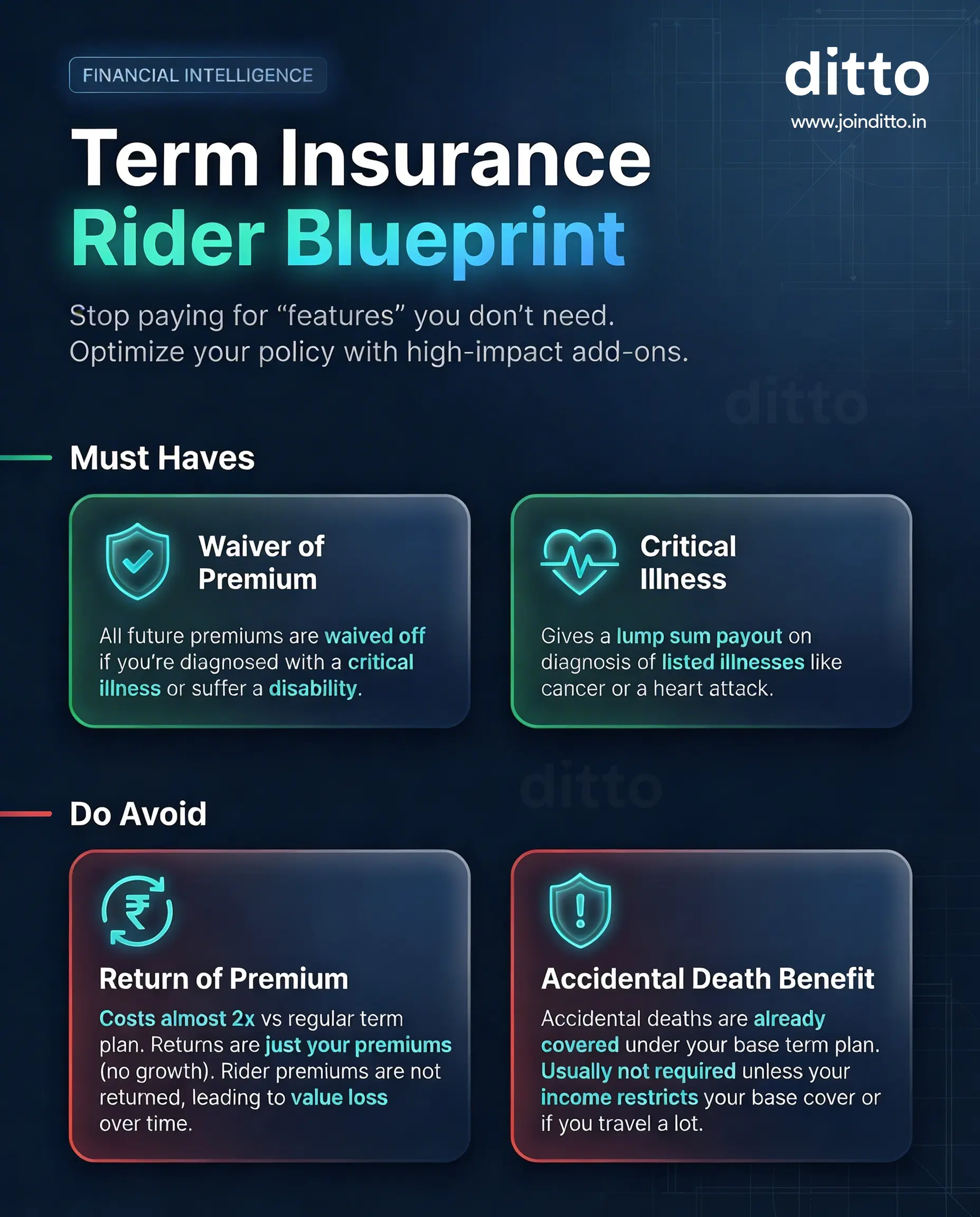
- Critical Illness: Provides a lump sum on diagnosis of covered illnesses such as cancer, heart attack, or kidney failure. Covered illnesses range from 10 to 64, depending on the plan.
- Waiver of Premium: Waives all future premiums if the policyholder is diagnosed with a critical illness or suffers from total and permanent disability, while the policy remains active.
- Accidental Total and Permanent Disability: Pays out if the policyholder becomes permanently disabled due to an accident.
Note: Do not add every available rider just because it sounds comprehensive. Each rider increases the premium, and in a TROP plan, the total cost is already high, and rider premiums are not refunded. For more details on which riders to consider, you can check out our comprehensive guide on term insurance riders or refer to the attached infographic.
How to File a Term Insurance With Return of Premium Claim?
For a Maturity Claim (ROP Payout):
Step 1: The insurer usually reaches out close to the policy maturity date, but don't wait. Contact your insurer or advisor at least 30 to 60 days before maturity.
Step 2: Fill out the maturity claim form (available on the insurer's website or through your advisor).
Step 3: Submit supporting documents: your original policy document, a valid ID proof, your PAN card, a canceled cheque or bank passbook for the refund, and a recent photograph.
Step 4: The insurer typically processes the payout within 15 to 30 days of receiving complete documentation.
Note: IRDAI says the insurers should process immediately on the due date.
For a Death Claim:
Step 1: The nominee must inform the insurer as soon as possible.
Step 2: Submit the claim form along with the death certificate, original policy document, the nominee's ID and address proof, and bank details.
Step 3: Under IRDAI regulations, insurers must settle claims within 15 days of receiving all documents, or within 45 days if an investigation is required.
If you purchased your plan through Ditto, you can also reach out to us for claims assistance.
Why Choose Ditto for Term Insurance?
At Ditto, we’ve assisted over 12,00,000 customers with choosing the right insurance policy. Why customers like Aaron below love us:
- 100% Free Consultation
- No Spam. No Sales Pressure.
- Rated 4.9/5 on Google Reviews by 30,000+ Happy Customers
- Backed by Zerodha
- Dedicated Claim Support Team
- Compare Plans and Premiums with a Trusted Insurance Advisor
Confused about the right insurance? Speak to Ditto’s certified advisors for free, unbiased guidance. Book your call now or chat with us on WhatsApp. Slots fill up fast!
Ditto’s Verdict on Term Insurance With Return of Premium
At Ditto, our position on TROP is clear: we don't recommend it because we wouldn't buy it ourselves.
You are paying 60% to 100% more than a standard term plan, sometimes even more, to get your own money back after 30 to 40 years. In our experience at Ditto, that extra premium is almost always better used in one of two ways.
- The most obvious alternative is to buy a pure term plan and invest the premium difference in simple, low-risk instruments such as the Public Provident Fund, fixed deposits, or debt mutual funds.
- Use the extra premium to buy more coverage. That extra coverage protects your family when dependency is highest. Your premiums are not "wasted" when they go toward a larger life cover. They are doing exactly the job they are meant to do.
If the real concern is, "I don't want to pay for decades and get nothing back if I survive," a Smart Exit feature answers that directly, at no extra cost.
It lets you voluntarily exit the policy at a specific milestone during the term and receive a full refund of all base premiums paid up to that date. If you reach that exit window and your children are financially independent, your home loan is cleared, and your dependents no longer rely on your income, you can choose to walk away with your money back. If your family still needs the cover, you simply continue the policy.
Frequently Asked Questions
Customer Reviews
Last updated on: