


Overview
Is Niva Bupa Health Insurance reliable when it is time to claim? That is the real test of any insurer, and it matters more than the features listed in a brochure.
Niva Bupa offers some of the most feature-rich plans in the market, and its latest products and improving service metrics make it worth a fresh look. Still, reliability depends on how it handles claims, complaints, and hospital access, because that decides whether those features reach you when you need them.
Even the features need a careful read. Not every headline feature works as simply as it sounds, and a few trade-offs are worth understanding before you buy.
In this Niva Bupa Health Insurance review, we look at its performance, top plans, claims process, hospital network, pros and cons, and whether it deserves a place on your shortlist.
Top Plans Offered by Niva Bupa Health Insurance
Niva Bupa Claim Process and Customer Care
For a Cashless Claim

Choose a Hospital
Visit a Niva Bupa network hospital. For eligible non-network hospitals, you can also check whether Cashless Everywhere is available, subject to insurer approval and policy conditions.
Share Policy Details
Provide your Niva Bupa health card or policy details, a valid ID, and any other documents as asked at the hospital insurance desk.
Pre-Authorization
The hospital sends a cashless request to Niva Bupa. Niva Bupa aims to respond to initial requests within 30 minutes, once it has the required documents and information. Under IRDAI timelines, insurers must decide on cashless requests within one hour of receiving them.
Treatment and Discharge
After treatment, the hospital submits the final discharge authorization request. Under IRDAI timelines, the insurer must provide final discharge authorization within three hours of receiving the hospital’s discharge request. In practice, the actual timeline may vary depending on the case.
Pay Non-Covered Expenses
You will still need to pay any deductibles, co-payments, non-payable items, or expenses outside the policy terms.
For a Reimbursement Claim
If cashless treatment is unavailable, pay the hospital yourself and submit the required bills and medical records to Niva Bupa. Its current service parameters specify 15 days to settle non-cashless claims after receipt of the required documents.
How to Contact Niva Bupa?
What if Your Complaint Is Not Resolved?
Talk to an expert
today and
find
the right
insurance for you.


Niva Bupa Network Hospitals
Niva Bupa has a network of 10,000+ hospitals across 450+ cities in India, where eligible claims can be settled on a cashless basis as per policy terms and conditions. Explore our detailed Niva Bupa health insurance network hospital guide for more information on the network, cashless claims, and hospital selection.
How to Find a Niva Bupa Network Hospital:
- Visit Niva Bupa’s official hospital network locator.
- Search using your location, hospital name, or treatment.
- Review the hospitals available near you and check the relevant network category under your policy.
- Shortlist 4–5 reliable hospitals close to your home or workplace rather than relying only on the overall 10,000+ figure.
- Recheck the Niva Bupa health insurance network hospital list before a planned hospitalization, since hospital tie-ups can be added, removed, or changed over time.
Ditto’s Take: Don’t choose an insurer purely because it has 10,000+ hospitals nationally. Search for the 3-5 hospitals you would realistically use near your home or workplace and confirm that they are currently available for cashless treatment.
Niva Bupa: Performance Metrics
Source: This information is sourced from the IRDAI annual reports and Niva Bupa public disclosures. For more data on other insurers, explore Ditto Data Lab.
Pros & Cons of Niva Bupa
Pros of Niva Bupa
- Strong Retail Plans: ReAssure 3.0 and Aspire offer differentiated features, including unlimited SI, maternity/newborn benefits, restoration, and flexible add-ons.
- More Open Underwriting: ReAssure 3.0 may accommodate some medical histories that other comprehensive plans may decline, although exclusions or conditions can apply.
- Improving Claims Experience: Niva Bupa’s CSR improved to 94.44% in FY2025-26, while complaints fell to about 29.19 per 10,000 claims, its lowest level.
- In-House Retail Claims: Niva Bupa handles individual retail claims in-house, giving it direct control over the claims process.
- PED Coverage Options: Select plans offer day 1 or reduced waiting periods for certain Pre-Existing Diseases (PED), subject to underwriting and loadings.
- Growing Scale: Niva Bupa’s health business has expanded rapidly, with GWP roughly tripling over four years.
Cons
- Lock the Clock Needs Caution: This benefit is variant-specific and should not be treated as a permanent premium freeze. Product-level repricing can still increase premiums over time, subject to applicable regulatory requirements.
- Still Trails on Some Metrics: Despite recent improvement, Niva Bupa's FY2025-26 CSR of 94.4% and its 10,000+ network hospitals are lower than those of HDFC ERGO, Aditya Birla Health Insurance, and Care Health Insurance.
- Conditional Benefits: Features such as day 1 PED coverage, restoration, and Lock the Clock have eligibility rules, triggers, or underwriting conditions.
Ditto’s Take on Lock the Clock
Niva Bupa Health Insurance vs. Other Leading Health Insurance Providers
Niva Bupa’s closest competitors are other Standalone Health Insurers (SAHIs) such as Care, Aditya Birla, Star, and ManipalCigna. It also competes with general insurers such as HDFC ERGO, Bajaj General, and ICICI Lombard. A proper comparison should consider claim settlement, complaints, hospital network, and product fit, not premiums alone.
- Aditya Birla: Among standalone insurers, Aditya Birla outperforms Niva Bupa on CSR (96.25% vs. 92.92%), complaints (18.67 vs. 37.13 per 10,000 claims), and network size (16,500+ vs. 10,000+) for FY 24-26.
- HDFC ERGO: Among general insurers, HDFC ERGO has stronger operating metrics, with a 97.61% CSR, 8.87 complaints per 10,000 claims, and a 16,000+ hospital network for FY 24-26.
- Star Health: Niva Bupa performs better on two key service metrics, with a higher CSR (92.92% vs. 88.63%) and fewer complaints (37.13 vs. 54.04 per 10,000 claims). Star, however, has a larger network of 14,000+ hospitals.
Where Niva Bupa Stands Out: Its advantage is product fit rather than overall operating metrics. ReAssure 3.0 has relatively open underwriting for certain complex medical histories, while Aspire stands out for newborn coverage up to the base sum insured. While the three-year averages still show higher complaint levels than the industry average, Niva Bupa’s latest CSR has improved, and complaints per 10,000 claims have declined, indicating a better recent service trend.
Why Choose Ditto for Health Insurance?
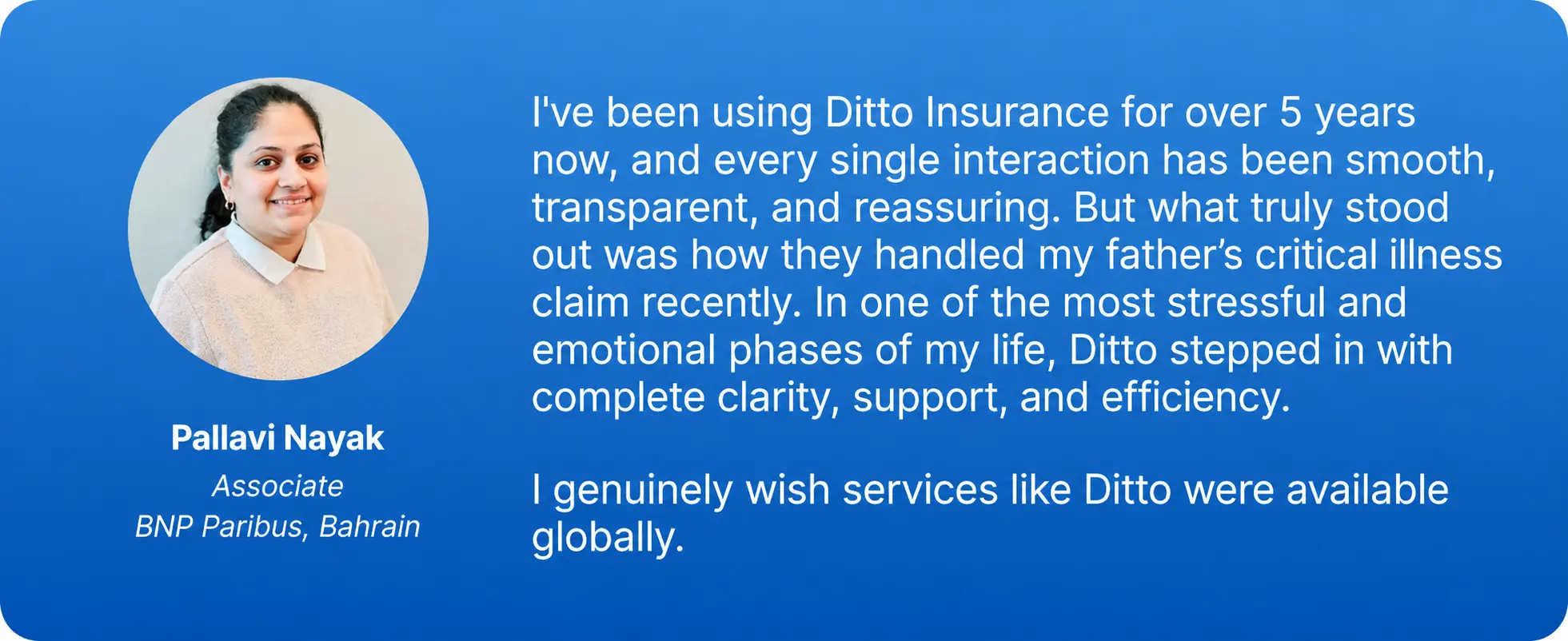
At Ditto, we’ve assisted over 12,00,000 customers choose the right insurance policy. Why customers like Pallavi love us:
- 100% Free Consultation
- No Spam. No Sales Pressure.
- Rated 4.9/5 on Google Reviews by 30,000+ Happy Customers
- Backed by Zerodha
- Dedicated Claim Support Team
- Compare Plans and Premiums with a Trusted Insurance Advisor
Confused about the right insurance? Speak to Ditto’s certified advisors for free, unbiased guidance. Book your call now or chat with us on WhatsApp. Slots fill up fast!
Conclusion
Niva Bupa has improved meaningfully, with better claims metrics, a stronger product lineup, and more flexible underwriting for certain medical histories. However, whether it is the right choice depends heavily on the plan, your medical history, and the features you actually need.
ReAssure 3.0 stands out for unlimited SI and its relatively open underwriting in certain complex medical cases, while Aspire is particularly relevant for buyers prioritizing maternity and newborn coverage. At the same time, Niva Bupa still trails some competitors on operational metrics, so these trade-offs matter.
Before deciding, compare Niva Bupa with our best health insurance companies in India to see which policy fits your needs.
Frequently Asked Questions
Last updated on: