Care Health Insurance is a dependable provider in India with strong claim settlement metrics and comprehensive modern plans.
Key Strengths
High Claim Settlement Ratio (CSR): The insurer reports a strong CSR of 95.45% for FY 24-26, above the industry average of 92.02% and ditto’s benchmark of 90.00%.
Hospital Network: Care Health allows cashless treatment through its robust network of more than 11,400 hospitals.
Plan Benefits: The insurer’s flagship plan, Care Supreme, includes key features such as zero co-payment, no room-rent restrictions, and unlimited automatic sum insured restorations.
Care Health also reports a high complaint volume of 42.67 complaints per 10,000 claims for FY 24-26. But this shouldn’t be the only cause for concern, because this number is also higher because Care Health is a standalone health insurer.
In FY 2025–26, Care Health Insurance settled 96.99% of claims, while its business volume crossed ₹10,000 crore. However, claims performance is only one part of the picture. Plans, premiums, complaints, exclusions, and policy terms also matter.
In this article, we’ll answer “Is Care Health Insurance good?” by looking at its plans, key features, performance metrics, and sample premiums. We’ll also explain the claims process, discuss the pros and cons, and outline what to consider before deciding.
No Room Rent Limit and No Co-Payment: You pick the room, and Care pays its share of the bill.
Unlimited Automatic Restoration: If your cover runs out (fully or partly) during the year, it refills. It works for the same illness or a different one.
Cumulative Bonus: Your cover grows by 50% each year, up to 100% of your base sum insured, whether or not you claim.
Waiting Periods: 30 days for general illnesses (accidents are covered from day one), 2 years for specific illnesses, and 3 years for pre-existing conditions.
Care Ultimate
Care Ultimate is Care's newest comprehensive plan. It's built for people who plan to stay insured long term.
Sum Insured: ₹5 lakh to ₹1 crore.
No Co-Payment, No Room-Rent Limit, and No Disease-Wise Sub-Limits: A sub-limit is a cap on what the insurer pays for a specific treatment, like cataract surgery.
Unlimited Automatic Restoration: Your sum insured gets restored during the policy year.
Pre- and Post-Hospitalization Cover: 60 days before and 90 days after your stay.
Waiting Period for Pre-existing Diseases: 3 years. An add-on can reduce this to 30 days for certain conditions.
Multi-Year Policies: Up to 5 years, which helps you avoid yearly price hikes.
It also has features like Premium Payback, which returns your first-year premium after every 5 claim-free years. Like Supreme, it doesn't cover maternity.
Other Care Health Plans
01
Care Plus
A comprehensive plan with unlimited restoration, an inflation shield, annual health checkups, and no co-payment.
02
Care Advantage
For big cover needs. It goes up to ₹6 crore, with no room rent limit, no disease sub-limits, and an optional global cover add-on.
03
Care Heart
Made for people with heart conditions. Sum insured options range from ₹3 lakh to ₹10 lakh, with a 24-month waiting period for pre-existing conditions.
04
Care Freedom
Made for people with conditions like diabetes, hypertension, or high BMI. Sum insured options run from ₹3 lakh to ₹10 lakh, with a 24-month wait. It comes with disease-wise sub-limits, so check them carefully.
05
Supreme Enhance Super Top-Up
Adds ₹20 lakh to ₹1 crore of extra cover on top of your base plan. It kicks in after a deductible of ₹5 lakh to ₹15 lakh. It also offers unlimited restoration and a cumulative bonus, which is rare in super top-ups.
Talk to an expert today and find the right insurance for you.
Real Life Claim Story
One of Ditto's customers bought a Care Supreme policy through us. Their child had been previously diagnosed with Myopia, which was disclosed in the application form. Care issued the policy without any Pre-Existing Disease (PED) waiting period.
A year later, the customer filed an AYUSH reimbursement claim for their child, which was initially declined by the insurer due to Myopia being a PED.
Ditto's claims team shared the application form showing the disclosure and noted that Care did not apply any PED waiting period for the condition during underwriting.
After reviewing the case, Care Health approved the claim.
Takeaway: In Ditto's experience, Care Health responds positively to requests, reviews cases on their merits, and is willing to reverse a decision when the documentation clearly supports the customer.
Solvency Ratio: IRDAI requires insurers to keep a solvency ratio of at least 1.5x, which shows they can pay claims even in a bad year. Care Health reports a solvency ratio of 1.68x as of March 2026.
Care Health Insurance: Sample Premium Illustration by Age & Cover
Profiles
Care Supreme
Care Ultimate
(Individual Plan): Age 25
₹16,294
₹9,869.46
(Family Floater, 2A): Ages (31, 32)
₹23,153
₹15,294.29
(Family Floater, 2A 1C): Ages (35, 34, 5)
₹29,257
₹20,217.09
(Family Floater, 2A): Ages (62, 63)
₹86,069
₹60,040.78
Note: A stands for adult, C stands for child. For this comparison, we’ve taken sample profiles of healthy individuals living in Delhi (pincode: 110010) and covered for a sum insured of ₹15 lakh. These are indicative premiums which include recommended add-ons and discounts. They may vary based on your exact location, health history, and selected add-ons.
How Does the Care Health Insurance Claim Process Work?
Cashless Claims (At a Network Hospital)
Go to a network hospital and visit its insurance desk. Share your policy details and ID.
Tell Care about the admission. For planned treatment, do this at least 48 hours before admission. For emergencies, inform Care within 24 hours of admission. You can do this through the Claim Genie app, the website, or email.
The hospital sends a pre-authorization request, which is simply a request for approval, to Care.
Care checks it against your policy terms. Once approved, Care pays the hospital directly.
You pay only for items your policy doesn't cover.
Reimbursement Claims
Pay the hospital bills yourself.
Collect your documents: claim form, discharge summary, bills, and test reports.
Submit them to Care within 15 days of discharge.
Care reviews them and pays the eligible amount to your bank account.
Ditto’s Key Tip: Keep every bill and report, even small ones. Missing paperwork is one of the most common reasons claims get delayed.
Care Health Insurance: Pros and Cons
Pros of Care Health Insurance
Cons of Care Health Insurance
Strong Claim Settlement Ratio (CSR): CSR of 96.99% in FY 2025–26, backed by large business volumes.
Higher Complaint Volume: 42.67 complaints per 10,000 claims vs. an industry average of 29.35.
Highly Customizable Plans: Add-ons cover wellness, gym memberships, OPD (doctor visits without hospital admission), and chronic illnesses.
Some Features Cost Extra: Air ambulance, consumables cover, and health checkups may require additional premiums.
In-House Claim Settlement Team: Care handles claims internally, reducing the need for files to pass between multiple parties.
No Maternity Cover: Care Supreme and Care Ultimate don't include maternity coverage.
Budget-Friendly Premiums: Comprehensive plans are available at competitive prices.
-
Why Choose Ditto for Health Insurance?
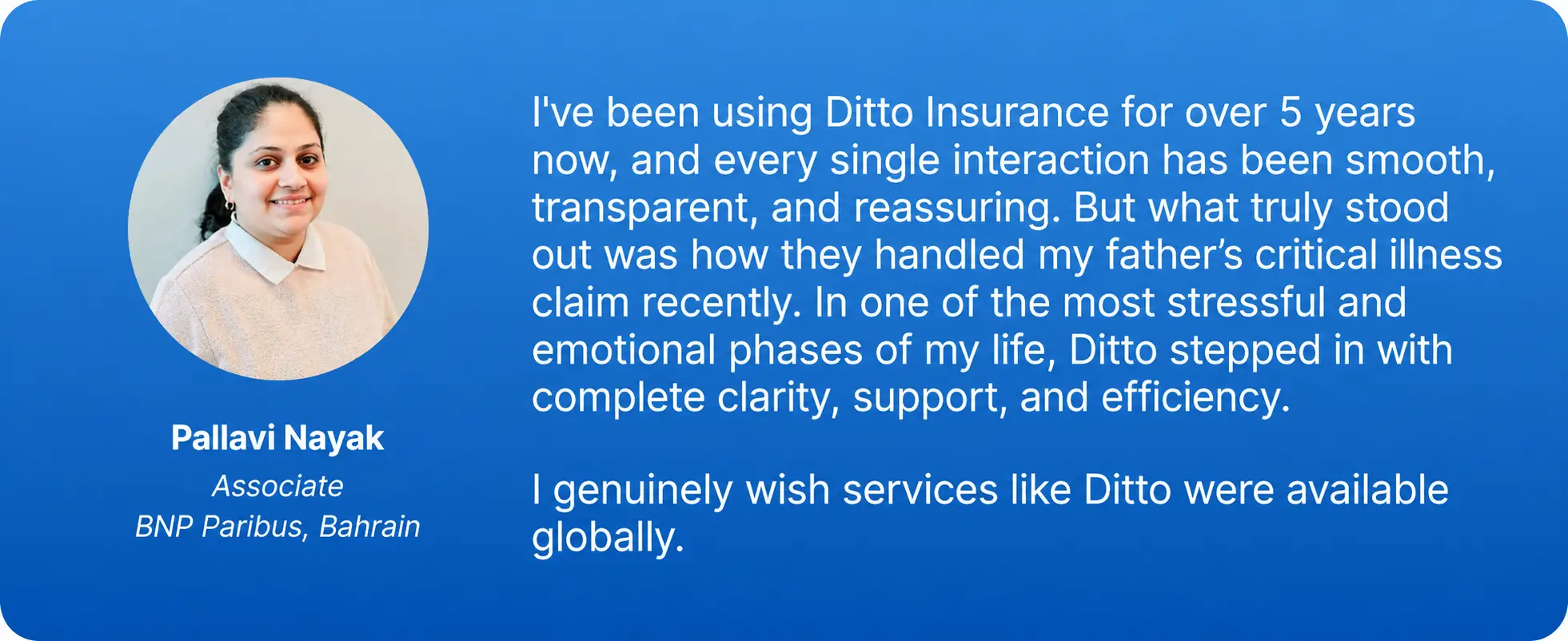
At Ditto, we’ve assisted over 12,00,000 customers choose the right insurance policy. Why customers like Pallavi love us:
100% Free Consultation
No Spam. No Sales Pressure.
Rated 4.9/5 on Google Reviews by 30,000+ Happy Customers
Backed by Zerodha
Dedicated Claim Support Team
Compare Plans and Premiums with a Trusted Insurance Advisor
Confused about the right insurance? Speak to Ditto’s certified advisors for free, unbiased guidance. Book your call now or chat with us on WhatsApp. Slots fill up fast!
Conclusion: Is Care Health Insurance Good?
Care Health Insurance is a good choice for most people. Its claim settlement ratio is strong and improving, its plans are flexible, and premiums are reasonable. Its complaint volume is higher than the industry average, but our experience with Care has been smooth, and the team is open to resolving issues.
Frequently Asked Questions
Is Care Health Insurance good for claims?
Yes. Care Health Insurance reported a claim settlement ratio of 96.99% in FY 2025–26, compared with the industry average of 92.02%. It also has an in-house claim settlement team, meaning claims are handled internally rather than relying entirely on an external TPA. However, claim approval still depends on policy terms, exclusions, waiting periods, and documentation. In Ditto’s experience, Care is also fairly open to reviewing cases and resolving claim-related issues through back-and-forth communication.
Is Care Health Insurance a government or private company?
Care Health Insurance is a private standalone health insurance company regulated by the Insurance Regulatory and Development Authority of India (IRDAI). It was established in 2012 as Religare Health Insurance and was later renamed Care Health Insurance. Since it is a standalone health insurer, its business is focused primarily on health-related products rather than life, motor, and other general insurance categories. Its portfolio includes comprehensive health plans, disease-specific policies, senior-focused products, and super top-up plans.
Which is the best Care Health Insurance plan?
Care Supreme is Care Health’s flagship comprehensive policy and ranks second on Ditto’s list of the best health insurance plans in India. It offers no room-rent restrictions, no mandatory co-payment, unlimited automatic restoration, and a cumulative bonus. Care Ultimate can be worth considering if you want a lower-priced comprehensive plan with long-term features such as Premium Payback and optional waiting-period reductions. The better choice ultimately depends on your age, medical history, required coverage, preferred hospitals, and budget.
Does Care Health Insurance cover pre-existing diseases?
Yes, Care Health Insurance plans can cover pre-existing diseases, but usually only after the applicable waiting period is completed. Care Supreme and Care Ultimate have a standard three-year waiting period for pre-existing conditions. Care Ultimate also offers an optional benefit that can reduce the waiting period to 30 days for certain specified conditions, subject to policy terms. Plans designed for people with existing medical conditions, such as Care Heart and Care Freedom, have a shorter 24-month pre-existing disease waiting period.
Why are there more complaints against Care Health Insurance?
Care Health recorded an average complaint volume of 42.67 complaints per 10,000 claims for FY 2024–26, compared with the industry average of 29.35. One factor to consider is that Care is a standalone health insurer, so its insurance business and claims are concentrated in health insurance, where claim disputes can be relatively complex. The number should still be considered alongside claim settlement performance. In Ditto’s experience, Care has generally been open to discussions, claim reviews, and resolving issues when escalated.
Does Care Health Insurance offer cashless treatment?
Yes. Care Health Insurance offers cashless hospitalization through a network of more than 11,400 hospitals across India. At a network hospital, the hospital submits a pre-authorization request to Care, and once the treatment is approved, the insurer directly settles the eligible portion of the bill with the hospital. For planned hospitalization, Care should be informed at least 48 hours before admission. For emergency hospitalization, notify the insurer within 24 hours. The policyholder must still pay any non-covered expenses.
Does Care Supreme or Care Ultimate cover maternity?
No. Neither Care Supreme nor Care Ultimate provides maternity coverage under the standard policy, and maternity cannot currently be added through an optional maternity add-on under these plans. So, if pregnancy and childbirth expenses are an important part of your insurance requirement, these policies may not be suitable for that specific need.
Care Health Customer Reviews
4.6
86 reviews
I bought a Care Health plan for my parents because their 11,000+ hospital network covers smaller cities well where other insurers have limited options. The coverage has been very useful and the policy terms are clear.
SR
Sudhir Reddy
My cashless claim under the Care Supreme plan was processed smoothly. Pre-authorisation came through quickly and the discharge was handled without any stress. Very happy with how the claim process went.
MK
Manju Krishnamurthy
Care Health's premium for the coverage it offers is very competitive compared to other standalone health insurers. The plan customisation through add-ons is a genuine advantage. Good value for money overall.
RP
Rakesh Pandey
My Ditto advisor recommended Care Health after explaining that the Supreme plan's features was very strong for the premium I'd be paying. They also helped me understand which add-ons were genuinely worth taking. Great clarity!
SI
Sunita Iyer
Care Health's complaint volumes are noticeably higher than other health insurers of a similar size. I had to follow up multiple times to get my reimbursement processed and the response times from their customer care were quite inconsistent.